
Designing for the Future: The Modernization of I-43 South Segment
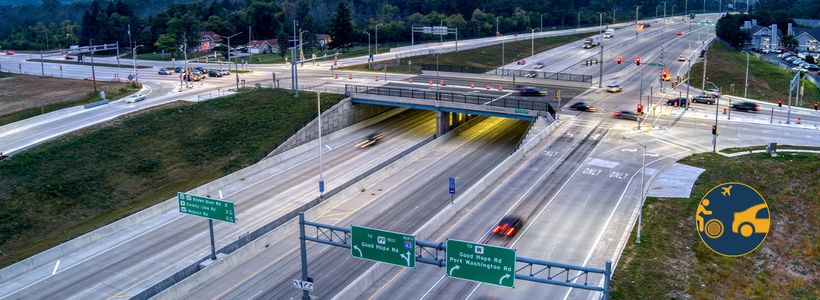
The I‑43 North – South Freeway is one of Southeastern Wisconsin’s busiest and most critical transportation corridors, carrying nearly 100,000 vehicles daily. Aging infrastructure, increasing traffic volumes and limited multimodal connectivity challenged the corridor’s ability to safely and efficiently serve the region. In response, the Wisconsin Department of Transportation (WisDOT) advanced a comprehensive modernization of the 14‑mile freeway to support long-term mobility and safety.
The 3.9‑mile South Segment, stretching from Bender Road to Brown Deer Road, was a key component of this effort. The team reconstructed and widened the freeway, upgraded interchanges and bridges, and improved frontage roads to enhance safety, capacity and multimodal connectivity while maintaining access for surrounding communities.
Collaboration
Successful delivery of the I‑43 South Segment relied on strong collaboration across a multidisciplinary team. As the project progressed, the onset of the COVID‑19 pandemic required an immediate transition to a fully remote work environment. The team adapted quickly, using digital collaboration tools to maintain communication, coordination and quality control without disrupting momentum.
Early and ongoing collaboration with WisDOT, municipalities and construction partners allowed construction insight to be integrated into the design process from the start, resulting in efficient staging strategies and informed decision-making. Clear, consistent communication and a culture of collaboration enabled the project team to remain flexible, responsive and aligned.
Safety and Mobility Improvements
The modernization required context‑sensitive improvements within a constrained urban corridor bordered by a historic property, high school campus and major arterial roadways. Years of coordination led to a shifted six‑lane alternative that expanded the freeway and Port Washington Road eastward, protecting adjacent properties while accommodating future traffic demands. Urban design elements such as retaining walls, concrete barriers and integral curbs minimized impacts, and created space for new sidewalks and bike lanes that improved connectivity for all users. A safety‑first approach guided construction staging, including wider temporary lanes and shoulders that maintained mobility and access.
Sustainability and environmental stewardship were also central to the project’s improvements. Following a multi‑year pause and restart, the team worked closely with state and federal agencies to refine solutions that reduced environmental impacts. These efforts included recycling existing pavement, balancing earthwork to limit excess material, carefully staging work to avoid sensitive habitats and wetlands, and protecting the Milwaukee River through drainage and water-quality enhancements.
Complex railroad constraints further shaped the project’s improvements. Replacing the UPRR bridge while maintaining active rail service and roadway traffic required innovative design, advanced geotechnical solutions and precise staging. By constructing a new bridge parallel to the existing structure and adjusting track geometry, the team avoided temporary structures and streamlined construction.
 Diverging Diamond Interchange
A major improvement at the Brown Deer Road interchange addressed longstanding safety and capacity challenges associated with the existing cloverleaf configuration. The team implemented a diverging diamond interchange, repurposing the existing bridge structure to maximize remaining service life while minimizing costs. This innovative solution allowed traffic to be maintained on both I‑43 and Brown Deer Road during construction and positioned the interchange to better meet long‑term operational needs.
Successful Results
The I‑43 South Segment represents a $200 million investment in one of Southeastern Wisconsin’s most critical transportation corridors, delivering measurable improvements in safety, mobility and community connectivity. The project modernized a heavily traveled urban freeway while maintaining access for neighborhoods, schools and businesses.
Despite significant complexity, the project was delivered on schedule and under budget, with a final construction cost of approximately $197.8 million. During construction, wider temporary lanes and shoulders contributed to a 20% reduction in crashes. Additional benefits include enhanced pedestrian and bicycle facilities, noise walls to protect adjacent neighborhoods and improved stormwater management that reduced total suspended solids by more than 40% to protect the Milwaukee River. Since completion, the corridor has experienced a 43.7% reduction in crashes compared to preconstruction conditions, reflecting the effectiveness of the design improvements and safety‑focused approach.
Together, these outcomes demonstrate how thoughtful planning, collaboration and innovation can deliver lasting value while balancing regional mobility, environmental stewardship and community needs.
About the Guest Bloggers
 Ryan Janke, PE is a project manager at HNTB and also served as the project manager on the I-43 North-South Freeway South Segment project. HNTB Corporation is an employee-owned infrastructure firm serving public and private owners and contractors.
 Prasad Narayan, PE is a vice president with Kapur & Associates who served as a senior engineer on the I-43 North-South Freeway South Segment project. Kapur & Associates is a multidisciplinary engineering firm that has been serving public and private clients across the U.S. since 1981.